Blog
How to Choose an ADHD Planner That Actually Works
September 20, 2026
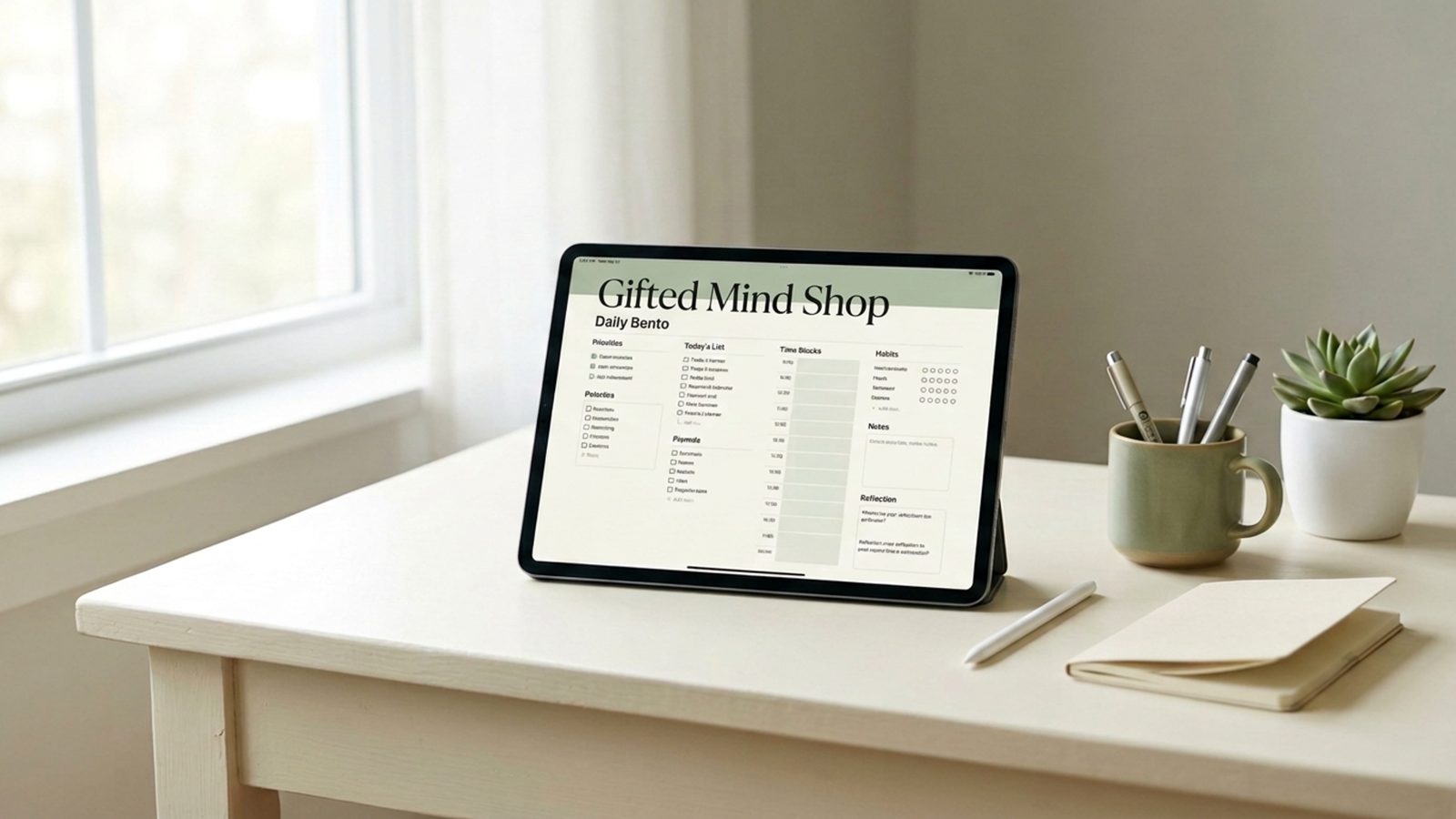
Generic planners were built for linear brains. Here is what actually makes an ADHD planner different, and what to look for if you are a late-diagnosed adult who has tried every system and abandoned them all.
Most ADHD planners are regular planners wearing a different label. They have the same grid, the same hourly blocks, the same assumption that you will check the same list at the same time every day. For a brain that doesn't work that way, they don't just fail to help. They remind you, every time you open them, that you're doing it wrong again.
If you're a late-diagnosed adult, you've probably tried more systems than you can count. Bullet journals, apps, color-coded binders, the expensive planner your coworker swore by. This guide breaks down what to actually look for, and what "built for ADHD" should mean in practice.
Why generic planners fail ADHD brains
A standard daily planner assumes a few things: that time feels linear, that priorities stay stable across the day, that starting a task is the easy part, and that one list is enough to keep your head clear.
ADHD adults deal with time blindness, which means an hour and a week feel about the same in terms of urgency until the deadline is ten minutes away. Generic planners don't account for that. They assume you can look at "3 PM: dentist" and feel the distance between now and then. You can't, and the planner won't help you feel it.
Executive function deficits show up differently too. When a planner is blank, it demands that you decide everything in the moment: what to do first, how long it will take, whether this is actually urgent or just feels that way. That decision load is exactly the part that's hard. A good ADHD planner pre-structures as many of those decisions as possible without removing flexibility.
The phrase bank from the ADHD community says it plainly: "I've always struggled with traditional planners. They never seem to work with how my ADHD brain operates." That's not a discipline problem. It's a design problem.
What to look for in an ADHD planner for adults
The most useful ADHD planners share a few design patterns:
Visual time representation. Your brain needs to see time, not just read it. Layouts that show time as blocks on a visible spectrum, rather than a list of hours, support time awareness in a way text lists don't.
A brain dump section. A dedicated space to offload every open loop, separate from the action list. Mental clutter is one of the biggest executive function drains. Getting it out of your head and onto paper, without sorting it yet, lowers the cost of starting.
Energy-aware structure. ADHD energy isn't consistent. Good templates leave room to mark your capacity for the day so you can calibrate the task list rather than repeating the same unrealistic plan every morning.
Low-friction customization. Pre-printed fields that don't fit your week feel binding, not helpful. The most useful ADHD systems are editable: you add what you need, leave out what you won't use, and adjust as weeks change.
Something that looks calm. This sounds minor. It isn't. If the tool feels punishing or clinical, you won't open it. A visually organized template is more likely to become a daily habit, not because design fixes ADHD, but because it reduces the friction of returning to it.
And a note on price: the commodity tier of ADHD planners ($2 to $4 PDF bundles) often delivers repackaged bullet journals with "ADHD" in the title. At that price point, there's no room for original design. You're buying a rename, not a rethink.
How the Calm Focus Starter Kit was built differently
The Calm Focus Starter Kit grew out of those design patterns applied to one specific person's real experience. The founder of Gifted Mind Shop was diagnosed with ADHD at 34. By then she had spent years adapting neurotypical planners to fit a non-linear brain, adding workarounds where the templates fought back.
The starter kit is a set of Canva templates built around a bento-grid structure: visible time blocks, a daily brain dump section, an energy check-in, and a short prioritized list. All of it edits in a free Canva account. No design skills required. You change what doesn't fit, leave the rest, and print or use it on your tablet.
"No more adapting a neurotypical planner to fit your life. These templates are built for the way your brain actually works."
It's not a fix for ADHD. No organizational aid is. But it removes enough friction that a daily planning practice becomes genuinely possible for many people who'd given up on the category.
What about ADHD daily planner Canva options?
Canva-based planners have a real advantage: you can edit every field, swap colors, resize sections, and print as many copies as you want from a free account. The barrier to customization is low, which matters for a brain that needs the tool to adapt to life, not the other way around.
The templates in the Calm Focus Starter Kit are built in Canva specifically because of that flexibility. If the brain dump section needs to be bigger this week, you resize it. If you want to remove the hourly blocks entirely for a gentler day, you delete them. The structure is a starting point, not a contract.
Frequently asked questions
Do I need Canva experience to use these templates? No. The templates open in a free Canva account. Editing is mostly typing over placeholder text and adjusting colors. Most buyers have a working version within 20 minutes of opening.
Are customizable ADHD templates better than paper planners? It depends on how you work. Digital templates like these print well and display clearly on tablets, so they work in both contexts. The customization is the main advantage: you're not stuck with a format that doesn't fit your workflow.
What's the difference between the Calm Focus Starter Kit and the Full Focus System? The Calm Focus Starter Kit is the entry point: a daily planner, a weekly overview, and a brain dump template. The Full Focus System builds on it with habit tracking, project planning, and a monthly reset spread. Start with the starter kit if you're not sure where to begin.
Is this a medical or therapeutic tool? No. These are organizational aids: productivity templates designed to work with non-linear thinking. They're not a treatment for ADHD or a substitute for professional support.